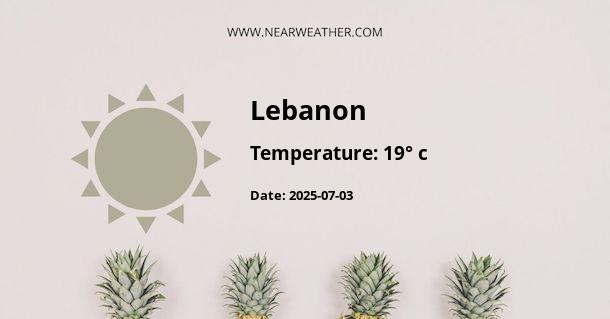
Lebanon Weather Today
Temperature, Feels Like, Rain Chance & Hourly Forecast in Lebanon
Lebanon temperature today is 17°, feels like 16°, with humidity at 70% and wind at 23.58 km/h. Rain chance today is 96%. Use the hourly forecast and 5-day outlook below to plan your day.


Sun & Moon


Location Info


Embed This Weather
Climate and Weather in the Republic of Lebanon
The Republic of Lebanon, located on the eastern coast of the Mediterranean Sea, experiences a Mediterranean climate characterized by hot, dry summers and cool, wet winters. The country's unique geography and topography contribute to its diverse climate patterns, with variations in temperature, precipitation, and wind patterns across different regions.
Temperature
Lebanon experiences a wide range of temperatures throughout the year, with significant variations between the coastal areas, mountainous regions, and the Bekaa Valley. In the coastal areas, including cities like Beirut and Tripoli, temperatures are moderate, ranging from an average high of 28°C (82°F) in summer to an average low of 13°C (55°F) in winter.
The mountainous regions, such as the Mount Lebanon range and the Anti-Lebanon Mountains, have cooler temperatures due to the higher elevation. Summers in the mountains are milder, with average highs of around 23°C (73°F), while winters can be cold, with average lows dropping to 4°C (39°F) or even below freezing in some areas.
The Bekaa Valley, situated between the mountains, experiences hotter temperatures compared to the coastal areas. Summers in the valley can be scorching, with average highs reaching 33°C (91°F) or higher. Winters are cooler but still relatively mild, with average lows around 8°C (46°F).
Precipitation
Lebanon's precipitation patterns are strongly influenced by the Mediterranean Sea and the surrounding mountain ranges. The country receives most of its rainfall during the winter months, typically between October and April. The coastal areas and the western slopes of the mountains receive higher amounts of rainfall compared to the eastern side of the mountains and the Bekaa Valley.
In the coastal areas, average annual rainfall ranges from 800 to 1,200 millimeters (31 to 47 inches), with the highest amounts occurring in the northern region. The mountainous regions receive even higher precipitation, with some areas receiving over 2,000 millimeters (79 inches) of rainfall annually. The Bekaa Valley, being in the rain shadow of the mountains, experiences lower rainfall, averaging around 300 to 400 millimeters (12 to 16 inches) per year.
Snowfall is common in the mountainous regions during the winter months, particularly at higher elevations. The ski resorts in the Cedars, Faraya, and Zaarour areas attract winter sports enthusiasts, taking advantage of the snow-covered slopes.
Wind Patterns
Lebanon experiences various wind patterns throughout the year, contributing to the country's climate. The prevailing winds during the summer months are the sea breezes, known as the "Shamal" in Arabic. These winds blow from the northwest, bringing cooler air from the Mediterranean Sea to the coastal areas and providing relief from the summer heat.
In winter, Lebanon is influenced by the westerly winds, known as the "Sharqi" in Arabic. These winds blow from the west and bring moist air from the Mediterranean, resulting in increased cloud cover and precipitation. The mountains act as a barrier, causing the air to rise and cool, leading to more significant rainfall on the western slopes.
Climate Zones
Lebanon can be divided into four main climate zones based on temperature and precipitation patterns:
- Coastal Zone: This zone experiences a Mediterranean climate with mild, wet winters and hot, dry summers. Average temperatures range from 13°C (55°F) in winter to 28°C (82°F) in summer, with annual rainfall between 800 and 1,200 millimeters (31 to 47 inches).
- Mountain Zone: The mountainous regions have cooler temperatures due to higher elevation. Summers are milder, with average highs around 23°C (73°F), and winters can be cold, with average lows dropping to 4°C (39°F) or below freezing. This zone receives higher precipitation, with some areas receiving over 2,000 millimeters (79 inches) of rainfall annually.
- Bekaa Valley: Situated between the mountains, the Bekaa Valley experiences hotter temperatures compared to the coastal areas. Summers can be scorching, with average highs reaching 33°C (91°F) or higher. Winters are cooler but still relatively mild, with average lows around 8°C (46°F). Annual rainfall in the valley averages around 300 to 400 millimeters (12 to 16 inches).
- Eastern Zone: The eastern side of Lebanon, including the eastern slopes of the mountains and the region bordering Syria, experiences a semi-arid climate. Summers are hot and dry, with temperatures exceeding 35°C (95°F). Winters are cooler but still relatively mild, with average lows around 6°C (43°F). This zone receives lower amounts of rainfall, averaging around 200 to 300 millimeters (8 to 12 inches) per year.
Conclusion
Lebanon's climate is primarily Mediterranean, with variations in temperature, precipitation, and wind patterns across different regions. The coastal areas enjoy moderate temperatures, while the mountainous regions and the Bekaa Valley experience cooler or hotter conditions depending on elevation. Lebanon's diverse climate zones offer a range of experiences for residents and visitors, from enjoying the mild coastal summers to skiing in the snow-covered mountains during winter.
What is the Latitude and Longitude of Lebanon?
Lebanon's Latitude is 33.833328 & Longitude is 35.833328.
What is the weather in Lebanon today?
Weather in Lebanon is 17° today.
What is the climatic condition of Lebanon today?
Climate Conditions in Lebanon shows scattered clouds today.
What is the humidity in Lebanon today?
Humidity in Lebanon is 70% today.
What is the wind speed in Lebanon today?
Wind speed in Lebanon is 23.58 km/h, flowing at 270° W wind direction.
What does it feel like in Lebanon today?
It feels like 16° in Lebanon today, with 50% cloud cover and 10 km visibility.