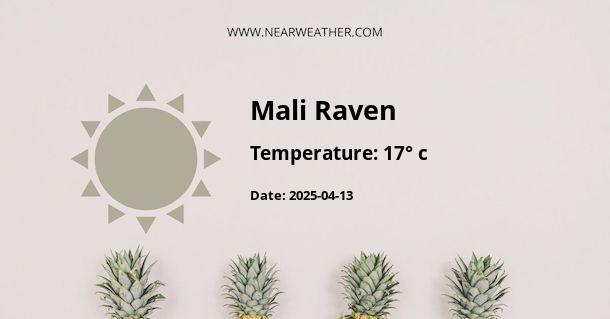
Mali Raven Weather Today
Daily Weather Forecast & Temperature in Mali Raven



Sun & Moon


Location Info


Embed This Weather
Exploring the Climate and Weather Patterns of Mali
Mali, a vast and culturally rich country in West Africa, is characterized by its diverse climate that varies across its geographical expanse. From the arid reaches of the Sahara in the north to the more fertile Sudanian Savanna in the south, Mali's climate zones shape not only the weather but also the livelihoods and patterns of life of its inhabitants.
The Climate Zones of Mali
The country primarily experiences three distinct climate zones:
- The Saharan Climate Zone (desert): This encompasses the northern part covering about a third of the national territory, predominantly characterized by very hot, dry conditions with minimal rainfall.
- The Sahelian Climate Zone (semi-arid): A transitional zone between the desert north and the wetter south, where rainfall is erratic and temperatures are high.
- The Sudanian Climate Zone (tropical savanna): This dominates the southern part of Mali, characterized by more pronounced seasonal changes with a wet season and a dry season.
Temperature and Precipitation Patterns
In Mali, air temperature and precipitation exhibit considerable seasonality and variability, which are influenced by two major wind systems—the Harmattan and the West African Monsoon.
- Harmattan: This is a dry and dusty northeasterly trade wind that originates from the Sahara Desert. It typically lowers humidity, obscures the sun, and can lead to significantly cooler temperatures, particularly during the night.
- West African Monsoon: On the other hand, the West African Monsoon brings a hot, moist southwest wind from the Atlantic Ocean. This results in the wet season, usually occurring between June and September, when most of the annual rainfall in Mali is recorded.
Average Temperature and Rainfall Statistics
The following tables provide average temperature and rainfall statistics for northern, central, and southern regions of Mali, reflecting the diversity of its climate:
Temperature (°C)
| Region | Jan | Feb | Mar | Apr | May | Jun | Jul | Aug | Sep | Oct | Nov | Dec |
|---|---|---|---|---|---|---|---|---|---|---|---|---|
| Timbuktu (North) | 24 | 26 | 29 | 33 | 35 | 38 | 37 | 36 | 35 | 31 | 27 | 24 |
| Mopti (Central) | 24 | 28 | 32 | 36 | 38 | 35 | 31 | 30 | 31 | 32 | 28 | 24 |
| Bamako (South) | 24 | 28 | 32 | 33 | 32 | 30 | 27 | 26 | 27 | 30 | 30 | 27 |
Monthly Rainfall (mm)
| Region | Jan | Feb | Mar | Apr | May | Jun | Jul | Aug | Sep | Oct | Nov | Dec |
|---|---|---|---|---|---|---|---|---|---|---|---|---|
| Timbuktu (North) | 0 | 0 | 0 | 0 | 4 | 16 | 53 | 67 | 29 | 4 | 0 | 0 |
| Mopti (Central) | 0 | 0 | 0 | 4 | 40 | 94 | 150 | 199 | 127 | 25 | 0 | 0 |
| Bamako (South) | 1 | 1 | 3 | 30 | 81 | 178 | 220 | 286 | 224 | 95 | 15 | 3 |
Weather Extremes and Variability
In recent decades, Mali has witnessed significant climate variability with growing concerns over the intensification of extreme weather events. Prolonged periods of drought followed by heavy rainfall leading to floods have severe implications for agriculture, food security, and human health.
Seasonal Changes and What to Expect
Visitors to Mali should be aware of the seasonal changes that can markedly alter the climate experience depending on the time of year:
- The Dry Season (October to February): Daytime temperatures are warm to hot, but nights can be cool, especially in the north. This is generally the most pleasant time to visit Mali.
- The Hot Season (March to May): Across the country, temperatures can soar, becoming challenging, especially in the desert regions where they can exceed 40°C (104°F).
- The Wet Season (June to September): The south experiences its rainy season, which can limit travel due to poor road conditions and lead to a higher risk of mosquito-borne diseases.
Agriculture and Climate-Related Challenges
Agriculture in Mali, a backbone of the nation's economy, is predominantly rain-fed and hence acutely susceptible to climate variability. The reliance on a single annual rainy season for most of Mali's farmlands poses risks related to both excess and deficit moisture:
Subsistence farmers and pastoralists are particularly vulnerable to climatic shifts, which can alter grazing patterns, reduce crop yields, and exacerbate food insecurity.
Climate Adaptation and Weather Forecasting
Mali is investing in climate adaptation strategies and improving weather forecasting capabilities:
- Enhancing irrigation systems.
- Introducing drought-resistant crop varieties.
- Implementing early warning systems for weather extremes.
The Meteorological Authority and Its Role
Mali's meteorological authority plays a critical role in providing detailed weather forecasts, climatic data, and early warnings. Its services empower farmers, fishermen, and the general populace to make informed decisions to cope with the vagaries of weather and climate.
Conclusion
Understanding Mali's diverse climatic systems is vital for anyone looking to engage with this West African country, whether for travel, business, or research. The weather patterns are complex and intriguing, offering a clear picture of the challenges and adaptations in a landscape that ranges from desert to lush savanna.
Note: The statistical data used in this article should be verified with up-to-date resources, as climatic conditions can change and may not be accurately reflected in the above historical data.
What is the Latitude and Longitude of Mali Raven?
Mali Raven's Latitude is 45.983330 & Longitude is 16.483330.
What is the weather in Mali Raven today?
Weather in Mali Raven is 12° today.
What is the climatic condition of Mali Raven today?
Climate Conditions in Mali Raven shows broken clouds today.
What is the humidity in Mali Raven today?
Humidity in Mali Raven is 87% today.
What is the wind speed in Mali Raven today?
Wind speed in Mali Raven is 6.16 km/h, flowing at 4° N wind direction.
What does it feel like in Mali Raven today?
It feels like 11° in Mali Raven today, with 67% cloud cover and 10 km visibility.